| MOQ: | 1 |
| ราคา: | โปร่ง |
| บรรจุภัณฑ์มาตรฐาน: | แพ็คเกจการส่งออกมาตรฐาน |
| ระยะเวลาการจัดส่ง: | 30 วัน |
| วิธีการชำระเงิน: | ที/ที |
| ความสามารถในการจัดหา: | 10 ชุดต่อเดือน |
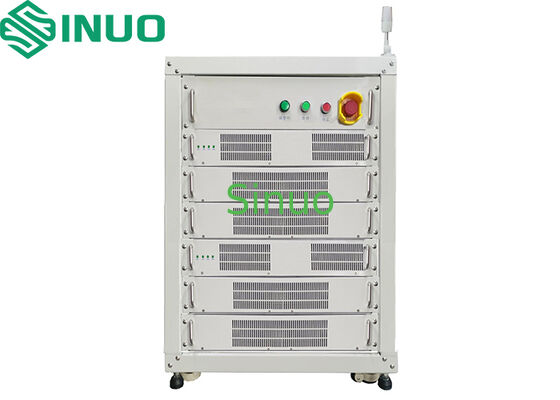
EN60950 Regenerative High-Precision Battery Pack Testing Equipment
Equipment Overview
The regenerative high-precision battery pack testing equipment can perform tests on various performance indicators of lithium-ion batteries such as capacity, state of charge, overcharge, and over-discharge. The device is characterized by high power, efficiency, precision, and performance. It uses regenerative energy feedback technology, which greatly reduces heat emission, energy consumption, and operating costs.
System Architecture
The equipment mainly consists of the host computer, middle computer, DC/AC modules, DC/DC modules, lower computer, and data acquisition and processing system. It can collect information in real time such as the voltage, current, capacity, and energy of each individual cell. The system optionally supports battery temperature data collection, and the collected data is stored in a specially designed database, providing various data statistics, analysis, and report generation functions.
![]()
Figure 1 System architecture diagram
System Main Functions:
1. Battery cycle life testing
2. Battery capacity testing
3. DC internal resistance testing
4. Charge/discharge characteristic testing
5. Charge retention testing
6. Charge/discharge efficiency testing
7. Deep discharge / constant voltage discharge testing
8. Overcharge and over-discharge tolerance testing
9. Temperature characteristic testing
System Main Features:
1. Regenerative energy feedback technology for high energy efficiency and minimal heat generation, significantly lowering power consumption and operating costs.
2. Three-phase balance technology (without neutral line), reducing grid load.
3. Soft-start feature to reduce the impact on the power grid during startup.
4. Precision of the device exceeds 0.05%, with data logging time of up to 1000 ms per cycle, and high stability.
5. Independent channels that allow for independent charge/discharge settings for each channel.
6. Complete input/output and protection features such as reverse connection protection, power-off resume protection, and poor contact protection.
7. No impact current at channel startup, seamless transition between constant current and constant voltage, with no current spikes.
8. Multi-layer network integration for centralized control via one PC, supporting over 1000 channels; large systems also support remote monitoring.
9. Channels can be freely paralleled as needed to expand functionality.
10. Modular design for easy maintenance.
11. Quick-connect output cables for easy installation and maintenance.
12. Gold-plated needle clamp fixtures reduce heating and facilitate easy battery loading/unloading.
13. Digital circuit design based on high-speed DSP processors for system control and processing.
14. Uses synchronous rectification technology for better energy efficiency and smaller hardware size.
15. With rich external device resources and high-speed digital processing capability to meet data processing and system control requirements.
16. Directly sends control variables via I/O ports to DSP for processing.
17. The system hardware is designed for simplicity and reliability.
18. Modular design facilitates system upgrades and maintenance.
Software Function Description
1. The device is mainly used for battery charge/discharge testing and related battery characteristic tests, with fully independent test channels. Through software programming control, users can program any current and voltage within the range for battery charging/discharging. Test data can be tracked by binding product information via barcode and monitored in real time during charge/discharge.
2. Safety protections: The device features reverse connection protection, voltage sampling line anomaly detection, and current testing line anomaly protection. If the battery is reversed, the channel cannot output or input current. It will also pause testing when voltage sampling lines are disconnected or the current line is poorly connected. The device includes power-off protection, overcurrent protection, overvoltage protection, and over-temperature protection for safe testing.
3. Process Workflow: Custom variables can be programmed to implement multiple test scenarios, with support for multi-layer nested cycles.
4. Independent Channel: Each channel has independently programmable constant current and constant voltage sources, with the ability to independently set test process steps.
5. Interrupt Continuation: In the case of power failure, communication interruption, or any other abnormality, the test will automatically resume from the last saved step when conditions are restored.
6. Offline Protection and Operation: When communication between the host and lower computer is interrupted, the system will enter offline operation mode. The device will pause when the lower computer loses power and resume testing after the issue is resolved.
7. Anomaly Detection: The system can accurately capture voltage and current changes. If voltage or current changes exceed certain thresholds, the device can automatically issue an alert and pause testing.
8. Log Tracking: The system includes a log function that records operation, anomalies, and other details during the test process for traceability and troubleshooting.
9. Device and Computer Interface: The device uses an RJ-45 Ethernet interface for stable and real-time remote data acquisition via the office network, enabling monitoring of the host system's operation in real-time.
10. Data Logging and Processing: The main channel can optionally support temperature or voltage channels to monitor battery temperature or voltage in real time. The data is simultaneously displayed, including total voltage, total current, total capacity, and auxiliary temperature channels.
11. Curve Analysis and Processing: The system has powerful curve analysis capabilities, allowing users to freely select the desired data sets for curves (such as voltage, current, capacity-time, capacity-voltage, and cycle count-final voltage). Curves can be zoomed, moved, and compared in various ways, and multiple data files can be compared.
Basic Step Settings
|
No. |
Basic Functions |
Function Introduction |
|
1 |
Charging Functions |
1. Constant Current Charging The channel outputs a constant current. The current output uses soft-start technology, avoiding any current surges. 2. Constant Voltage Charging The channel outputs a constant voltage, with no limitation on the output current (the output current is constrained by the maximum current value of the device's nominal model, controlled by the battery). 3. Constant Current-Constant Voltage Charging in Continuous Mode Both voltage and current are limited simultaneously, with the hardware automatically switching between the two modes. The current transition to constant voltage is seamless, without any current spikes, thanks to hardware soft-start. 4. Constant Power Charging The channel operates in a constant power charging mode, where the current is adjusted in real-time based on the battery's port voltage. 5. Constant Resistance Charging The channel operates in a constant resistance charging mode, where the current is adjusted in real-time based on the battery's port voltage. |
|
2 |
Discharge Functions |
1. Constant Current Discharge The channel discharges with a constant current. The current control uses soft-start technology, avoiding any current surges. 2. Constant Voltage Discharge The channel outputs a constant voltage, with no limitation on the output current (the output current is constrained by the maximum current value of the device's nominal model, controlled by the battery). 3. Constant Current-Constant Voltage Discharge in Continuous Mode Both voltage and current are limited simultaneously, with the hardware automatically switching between the two. The transition from constant current to constant voltage is seamless without current spikes, thanks to hardware soft-start. 4. Constant Power Discharge The channel operates in a constant power discharge mode, where the current is adjusted in real-time based on the battery’s port voltage. 5. Constant Resistance Discharge The channel operates in a constant resistance discharge mode, where the current is adjusted in real-time based on the battery’s port voltage. |
|
3 |
Standby Mode |
The current circuit is in a disconnected state, but data collection continues without interruption. |
|
4 |
Charge/Discharge DC Internal Resistance |
The DC internal resistance testing process can be custom-defined, providing a reliable basis for battery cell grouping. |
|
5 |
Cycle |
The test steps can be cycled based on actual requirements, with support for multi-layer nested cycles (up to 10 layers). |
|
6 |
Stop Mode |
The channel is completely stopped. The battery circuit is entirely disconnected from the device. |
Equipment Advantages
1. High energy feedback efficiency, with up to 85% efficiency during charging and discharging.
2. High output precision, with minimal current drift and high stability, thanks to 24-bit ADC units.
3. Safety protection features, including real-time monitoring of voltage and current lines.
4. Battery reverse connection protection ensures safety during testing.
5. Smooth transition from constant current to constant voltage, preventing damage to the battery.
6. Soft-start function for all charge/discharge steps to avoid current spikes.
7. High precision DC internal resistance test, ensuring reliable cell matching.
Technical Parameters
|
No. |
Item |
Specification |
||
|
1 |
Model |
SN552CTS-60V300A-2CH |
||
|
2 |
Main Channels |
2 channels |
||
|
3 |
Channel Operation Mode |
Fully independent |
||
|
4 |
Main Channel Operating Modes |
Charging: CC, CV, CCCV (smooth transition without impact) Discharging: CC, CP, CV Others: Standby, Stop |
||
|
Main Channel Test Termination Conditions |
Time, voltage, current, capacity, etc. |
|||
|
5 |
Main Channel Voltage |
Charging Voltage Range |
0V-60V |
|
|
Discharging Voltage Range |
8V-60V |
|||
|
Accuracy |
±(0.05%RD+0.05%FS) |
|||
|
Resolution |
0.1mV |
|||
|
Main Channel Current |
Max |
±300A |
||
|
Min |
±1200mA |
|||
|
Accuracy |
±(0.05%RD+0.05%FS) |
|||
|
Resolution |
0.1mA |
|||
|
Current Start Response Time |
≤20ms |
|||
|
Current Switching Time |
≤40ms |
|||
|
Time |
Resolution |
1000mS |
||
|
Power |
Output |
Max Continuous Output per Channel: 18000W |
||
|
Stability |
±0.1%FS |
|||
|
Efficiency |
Maximum Charge Efficiency |
85% |
||
|
Maximum Discharge Efficiency |
85% |
|||
|
Grid Feedback |
Harmonic Distortion |
≤3% |
||
|
Power Factor |
≥0.99 |
|||
|
Auxiliary Channel Cutoff Function |
The system allows setting conditions under which the main channel step will stop or switch when the auxiliary channel signal reaches a specified value. |
|||
|
6 |
Communication |
RJ-45 Ethernet interface for stable and real-time data transmission |
||
|
7 |
Control Program |
Supports power-off data protection, enabling test continuation after unexpected power failure, manual stop, or from saved data files. |
||
|
Safety limits can be configured, including lower and upper voltage limits, lower and upper current limits, and voltage/current trend protection.Protection can be set for each individual step. |
||||
|
Parameters such as upper/lower voltage limits and upper/lower temperature limits can be configured for the auxiliary channel. |
||||
|
Max cycles |
9999 |
|||
|
Nesting layers |
up to 10 |
|||
|
Time formats |
h / min / s |
|||
|
Data recording |
≥1000ms |
|||
|
8 |
Data Display |
Cycle List |
cycle number, charge/discharge capacity, energy, average voltage |
|
|
Process List |
process number, mode, time, capacity, energy, end voltage/current |
|||
|
Detail List |
record number, system time, cumulative time, voltage, current, power, energy |
|||
|
9 |
Date Export |
Data exportable to Excel and chart files; provides efficiency reports, charge/discharge curves, voltage/current-time characteristics, etc. |
||
|
10 |
Curve Types |
X-axis: total time, capacity, cycle count, etc. |
||
|
Y-axis:Total voltage, current, capacity, cell temperature, charge/discharge capacity, cell voltage, etc. — all can be freely configured. |
||||
|
11 |
Software Protection |
over/under-voltage, over/under-current, over-temp, power loss recovery, abnormal current fluctuation, etc. |
||
|
Hardware Protection |
reverse polarity, overcurrent, overvoltage. |
|||
|
Alarm |
emergency cut-off switch, auto shutdown, auto load connection/disconnection. |
|||
|
12 |
Output Lines |
Four-wire connection (separate current and voltage lines). |
||
|
13 |
Cooling |
Forced air cooling. |
||
|
14 |
Safety Level |
Complies with EN60950 and GB4943. |
||
|
Noise |
Tested according to the method specified in IEC 62040-3. Noise level is less than 75 dBA. The sound level meter used shall comply with Type I requirements of IEC 804, with an accuracy better than ±0.5 dB. |
|||
|
Protection level |
IP22 |
|||
|
15 |
Maintainability |
Modular design; spare parts replaceable; free maintenance during warranty period. |
||
|
16 |
Software Upgrade |
Lifetime free software upgrades (until hardware incompatibility). |
||
|
17 |
Failure Rate |
≤1% |
||
|
18 |
Appearance Color |
Ice Grey GY09; Cabinet: Machine Tool Grey GY10 (Customized colors are available upon request) |
||
|
19 |
Maintenance Direction |
Front and rear access |
||
|
20 |
Color |
Main unit: Ice Gray GY09 |
||
|
21 |
Environment |
Power Supply |
380VAC ±10%, three-phase five-wire, 50Hz ±5% |
|
|
Rated Power |
40kW |
|||
|
Ambient Temperature |
-20℃ ~ 40℃ |
|||
|
Humidity |
10%–90% RH, non-condensing |
|||
|
Other |
Avoid humidity, vibration, and dust; not for explosive or vaporous environments |
|||
|
22 |
Safety Notes |
1. Ensure proper grounding of the equipment. 2. Keep area around equipment clear and clean. 3. Do not open internal panels while operating. 4. Ensure test channels are idle before connecting or removing batteries. In case of emergency, press the emergency stop switch before any other operation. |
||
Main Control Interface
Process Flow Editing Interface
Host Computer Data Viewing Interface
Component List
|
No. |
Component |
Manufacturer |
Origin |
|
1 |
MCU |
ST / TI |
Italy / France / USA |
|
2 |
Fan |
Delta / Chint |
China |
|
3 |
Fuse |
Littlefuse / Bussmann |
USA |
|
4 |
IC |
TI / ON |
USA |
|
5 |
IGBT |
Infineon |
USA |
|
6 |
Sampling Resistor |
ISABELLENHÜTTE |
Germany |
|
7 |
AD |
TI |
USA |
|
8 |
DA |
ADI |
USA |
|
9 |
Relay |
OMRON |
Japan |
|
10 |
Breaker/Contactor |
CHINT / Delixi |
China |
|
11 |
Bidirectional Power Supply |
TuWei / Lorentz |
China |
|
12 |
Probe |
Kangxinda / Yingzhibao |
China |
Optional Accessories
|
No. |
Item |
Range / Accuracy |
Quantity |
Remarks |
|
|
1 |
Auxiliary Temperature Channel |
Temperature Probe Model |
NTC(R25=10KΩ±1% B25/50=3950±1%) |
As required |
Supplied upon delivery |
|
Temperature Probe Accuracy |
Range: -40℃ to 150℃ |
||||
|
2 |
Computer |
CPU: Intel 10th Gen i5 (6 cores or higher) |
As required |
Supplied upon delivery |
|
| MOQ: | 1 |
| ราคา: | โปร่ง |
| บรรจุภัณฑ์มาตรฐาน: | แพ็คเกจการส่งออกมาตรฐาน |
| ระยะเวลาการจัดส่ง: | 30 วัน |
| วิธีการชำระเงิน: | ที/ที |
| ความสามารถในการจัดหา: | 10 ชุดต่อเดือน |
EN60950 Regenerative High-Precision Battery Pack Testing Equipment
Equipment Overview
The regenerative high-precision battery pack testing equipment can perform tests on various performance indicators of lithium-ion batteries such as capacity, state of charge, overcharge, and over-discharge. The device is characterized by high power, efficiency, precision, and performance. It uses regenerative energy feedback technology, which greatly reduces heat emission, energy consumption, and operating costs.
System Architecture
The equipment mainly consists of the host computer, middle computer, DC/AC modules, DC/DC modules, lower computer, and data acquisition and processing system. It can collect information in real time such as the voltage, current, capacity, and energy of each individual cell. The system optionally supports battery temperature data collection, and the collected data is stored in a specially designed database, providing various data statistics, analysis, and report generation functions.
![]()
Figure 1 System architecture diagram
System Main Functions:
1. Battery cycle life testing
2. Battery capacity testing
3. DC internal resistance testing
4. Charge/discharge characteristic testing
5. Charge retention testing
6. Charge/discharge efficiency testing
7. Deep discharge / constant voltage discharge testing
8. Overcharge and over-discharge tolerance testing
9. Temperature characteristic testing
System Main Features:
1. Regenerative energy feedback technology for high energy efficiency and minimal heat generation, significantly lowering power consumption and operating costs.
2. Three-phase balance technology (without neutral line), reducing grid load.
3. Soft-start feature to reduce the impact on the power grid during startup.
4. Precision of the device exceeds 0.05%, with data logging time of up to 1000 ms per cycle, and high stability.
5. Independent channels that allow for independent charge/discharge settings for each channel.
6. Complete input/output and protection features such as reverse connection protection, power-off resume protection, and poor contact protection.
7. No impact current at channel startup, seamless transition between constant current and constant voltage, with no current spikes.
8. Multi-layer network integration for centralized control via one PC, supporting over 1000 channels; large systems also support remote monitoring.
9. Channels can be freely paralleled as needed to expand functionality.
10. Modular design for easy maintenance.
11. Quick-connect output cables for easy installation and maintenance.
12. Gold-plated needle clamp fixtures reduce heating and facilitate easy battery loading/unloading.
13. Digital circuit design based on high-speed DSP processors for system control and processing.
14. Uses synchronous rectification technology for better energy efficiency and smaller hardware size.
15. With rich external device resources and high-speed digital processing capability to meet data processing and system control requirements.
16. Directly sends control variables via I/O ports to DSP for processing.
17. The system hardware is designed for simplicity and reliability.
18. Modular design facilitates system upgrades and maintenance.
Software Function Description
1. The device is mainly used for battery charge/discharge testing and related battery characteristic tests, with fully independent test channels. Through software programming control, users can program any current and voltage within the range for battery charging/discharging. Test data can be tracked by binding product information via barcode and monitored in real time during charge/discharge.
2. Safety protections: The device features reverse connection protection, voltage sampling line anomaly detection, and current testing line anomaly protection. If the battery is reversed, the channel cannot output or input current. It will also pause testing when voltage sampling lines are disconnected or the current line is poorly connected. The device includes power-off protection, overcurrent protection, overvoltage protection, and over-temperature protection for safe testing.
3. Process Workflow: Custom variables can be programmed to implement multiple test scenarios, with support for multi-layer nested cycles.
4. Independent Channel: Each channel has independently programmable constant current and constant voltage sources, with the ability to independently set test process steps.
5. Interrupt Continuation: In the case of power failure, communication interruption, or any other abnormality, the test will automatically resume from the last saved step when conditions are restored.
6. Offline Protection and Operation: When communication between the host and lower computer is interrupted, the system will enter offline operation mode. The device will pause when the lower computer loses power and resume testing after the issue is resolved.
7. Anomaly Detection: The system can accurately capture voltage and current changes. If voltage or current changes exceed certain thresholds, the device can automatically issue an alert and pause testing.
8. Log Tracking: The system includes a log function that records operation, anomalies, and other details during the test process for traceability and troubleshooting.
9. Device and Computer Interface: The device uses an RJ-45 Ethernet interface for stable and real-time remote data acquisition via the office network, enabling monitoring of the host system's operation in real-time.
10. Data Logging and Processing: The main channel can optionally support temperature or voltage channels to monitor battery temperature or voltage in real time. The data is simultaneously displayed, including total voltage, total current, total capacity, and auxiliary temperature channels.
11. Curve Analysis and Processing: The system has powerful curve analysis capabilities, allowing users to freely select the desired data sets for curves (such as voltage, current, capacity-time, capacity-voltage, and cycle count-final voltage). Curves can be zoomed, moved, and compared in various ways, and multiple data files can be compared.
Basic Step Settings
|
No. |
Basic Functions |
Function Introduction |
|
1 |
Charging Functions |
1. Constant Current Charging The channel outputs a constant current. The current output uses soft-start technology, avoiding any current surges. 2. Constant Voltage Charging The channel outputs a constant voltage, with no limitation on the output current (the output current is constrained by the maximum current value of the device's nominal model, controlled by the battery). 3. Constant Current-Constant Voltage Charging in Continuous Mode Both voltage and current are limited simultaneously, with the hardware automatically switching between the two modes. The current transition to constant voltage is seamless, without any current spikes, thanks to hardware soft-start. 4. Constant Power Charging The channel operates in a constant power charging mode, where the current is adjusted in real-time based on the battery's port voltage. 5. Constant Resistance Charging The channel operates in a constant resistance charging mode, where the current is adjusted in real-time based on the battery's port voltage. |
|
2 |
Discharge Functions |
1. Constant Current Discharge The channel discharges with a constant current. The current control uses soft-start technology, avoiding any current surges. 2. Constant Voltage Discharge The channel outputs a constant voltage, with no limitation on the output current (the output current is constrained by the maximum current value of the device's nominal model, controlled by the battery). 3. Constant Current-Constant Voltage Discharge in Continuous Mode Both voltage and current are limited simultaneously, with the hardware automatically switching between the two. The transition from constant current to constant voltage is seamless without current spikes, thanks to hardware soft-start. 4. Constant Power Discharge The channel operates in a constant power discharge mode, where the current is adjusted in real-time based on the battery’s port voltage. 5. Constant Resistance Discharge The channel operates in a constant resistance discharge mode, where the current is adjusted in real-time based on the battery’s port voltage. |
|
3 |
Standby Mode |
The current circuit is in a disconnected state, but data collection continues without interruption. |
|
4 |
Charge/Discharge DC Internal Resistance |
The DC internal resistance testing process can be custom-defined, providing a reliable basis for battery cell grouping. |
|
5 |
Cycle |
The test steps can be cycled based on actual requirements, with support for multi-layer nested cycles (up to 10 layers). |
|
6 |
Stop Mode |
The channel is completely stopped. The battery circuit is entirely disconnected from the device. |
Equipment Advantages
1. High energy feedback efficiency, with up to 85% efficiency during charging and discharging.
2. High output precision, with minimal current drift and high stability, thanks to 24-bit ADC units.
3. Safety protection features, including real-time monitoring of voltage and current lines.
4. Battery reverse connection protection ensures safety during testing.
5. Smooth transition from constant current to constant voltage, preventing damage to the battery.
6. Soft-start function for all charge/discharge steps to avoid current spikes.
7. High precision DC internal resistance test, ensuring reliable cell matching.
Technical Parameters
|
No. |
Item |
Specification |
||
|
1 |
Model |
SN552CTS-60V300A-2CH |
||
|
2 |
Main Channels |
2 channels |
||
|
3 |
Channel Operation Mode |
Fully independent |
||
|
4 |
Main Channel Operating Modes |
Charging: CC, CV, CCCV (smooth transition without impact) Discharging: CC, CP, CV Others: Standby, Stop |
||
|
Main Channel Test Termination Conditions |
Time, voltage, current, capacity, etc. |
|||
|
5 |
Main Channel Voltage |
Charging Voltage Range |
0V-60V |
|
|
Discharging Voltage Range |
8V-60V |
|||
|
Accuracy |
±(0.05%RD+0.05%FS) |
|||
|
Resolution |
0.1mV |
|||
|
Main Channel Current |
Max |
±300A |
||
|
Min |
±1200mA |
|||
|
Accuracy |
±(0.05%RD+0.05%FS) |
|||
|
Resolution |
0.1mA |
|||
|
Current Start Response Time |
≤20ms |
|||
|
Current Switching Time |
≤40ms |
|||
|
Time |
Resolution |
1000mS |
||
|
Power |
Output |
Max Continuous Output per Channel: 18000W |
||
|
Stability |
±0.1%FS |
|||
|
Efficiency |
Maximum Charge Efficiency |
85% |
||
|
Maximum Discharge Efficiency |
85% |
|||
|
Grid Feedback |
Harmonic Distortion |
≤3% |
||
|
Power Factor |
≥0.99 |
|||
|
Auxiliary Channel Cutoff Function |
The system allows setting conditions under which the main channel step will stop or switch when the auxiliary channel signal reaches a specified value. |
|||
|
6 |
Communication |
RJ-45 Ethernet interface for stable and real-time data transmission |
||
|
7 |
Control Program |
Supports power-off data protection, enabling test continuation after unexpected power failure, manual stop, or from saved data files. |
||
|
Safety limits can be configured, including lower and upper voltage limits, lower and upper current limits, and voltage/current trend protection.Protection can be set for each individual step. |
||||
|
Parameters such as upper/lower voltage limits and upper/lower temperature limits can be configured for the auxiliary channel. |
||||
|
Max cycles |
9999 |
|||
|
Nesting layers |
up to 10 |
|||
|
Time formats |
h / min / s |
|||
|
Data recording |
≥1000ms |
|||
|
8 |
Data Display |
Cycle List |
cycle number, charge/discharge capacity, energy, average voltage |
|
|
Process List |
process number, mode, time, capacity, energy, end voltage/current |
|||
|
Detail List |
record number, system time, cumulative time, voltage, current, power, energy |
|||
|
9 |
Date Export |
Data exportable to Excel and chart files; provides efficiency reports, charge/discharge curves, voltage/current-time characteristics, etc. |
||
|
10 |
Curve Types |
X-axis: total time, capacity, cycle count, etc. |
||
|
Y-axis:Total voltage, current, capacity, cell temperature, charge/discharge capacity, cell voltage, etc. — all can be freely configured. |
||||
|
11 |
Software Protection |
over/under-voltage, over/under-current, over-temp, power loss recovery, abnormal current fluctuation, etc. |
||
|
Hardware Protection |
reverse polarity, overcurrent, overvoltage. |
|||
|
Alarm |
emergency cut-off switch, auto shutdown, auto load connection/disconnection. |
|||
|
12 |
Output Lines |
Four-wire connection (separate current and voltage lines). |
||
|
13 |
Cooling |
Forced air cooling. |
||
|
14 |
Safety Level |
Complies with EN60950 and GB4943. |
||
|
Noise |
Tested according to the method specified in IEC 62040-3. Noise level is less than 75 dBA. The sound level meter used shall comply with Type I requirements of IEC 804, with an accuracy better than ±0.5 dB. |
|||
|
Protection level |
IP22 |
|||
|
15 |
Maintainability |
Modular design; spare parts replaceable; free maintenance during warranty period. |
||
|
16 |
Software Upgrade |
Lifetime free software upgrades (until hardware incompatibility). |
||
|
17 |
Failure Rate |
≤1% |
||
|
18 |
Appearance Color |
Ice Grey GY09; Cabinet: Machine Tool Grey GY10 (Customized colors are available upon request) |
||
|
19 |
Maintenance Direction |
Front and rear access |
||
|
20 |
Color |
Main unit: Ice Gray GY09 |
||
|
21 |
Environment |
Power Supply |
380VAC ±10%, three-phase five-wire, 50Hz ±5% |
|
|
Rated Power |
40kW |
|||
|
Ambient Temperature |
-20℃ ~ 40℃ |
|||
|
Humidity |
10%–90% RH, non-condensing |
|||
|
Other |
Avoid humidity, vibration, and dust; not for explosive or vaporous environments |
|||
|
22 |
Safety Notes |
1. Ensure proper grounding of the equipment. 2. Keep area around equipment clear and clean. 3. Do not open internal panels while operating. 4. Ensure test channels are idle before connecting or removing batteries. In case of emergency, press the emergency stop switch before any other operation. |
||
Main Control Interface
Process Flow Editing Interface
Host Computer Data Viewing Interface
Component List
|
No. |
Component |
Manufacturer |
Origin |
|
1 |
MCU |
ST / TI |
Italy / France / USA |
|
2 |
Fan |
Delta / Chint |
China |
|
3 |
Fuse |
Littlefuse / Bussmann |
USA |
|
4 |
IC |
TI / ON |
USA |
|
5 |
IGBT |
Infineon |
USA |
|
6 |
Sampling Resistor |
ISABELLENHÜTTE |
Germany |
|
7 |
AD |
TI |
USA |
|
8 |
DA |
ADI |
USA |
|
9 |
Relay |
OMRON |
Japan |
|
10 |
Breaker/Contactor |
CHINT / Delixi |
China |
|
11 |
Bidirectional Power Supply |
TuWei / Lorentz |
China |
|
12 |
Probe |
Kangxinda / Yingzhibao |
China |
Optional Accessories
|
No. |
Item |
Range / Accuracy |
Quantity |
Remarks |
|
|
1 |
Auxiliary Temperature Channel |
Temperature Probe Model |
NTC(R25=10KΩ±1% B25/50=3950±1%) |
As required |
Supplied upon delivery |
|
Temperature Probe Accuracy |
Range: -40℃ to 150℃ |
||||
|
2 |
Computer |
CPU: Intel 10th Gen i5 (6 cores or higher) |
As required |
Supplied upon delivery |
|